The Eurasian Economic Union (EAEU) and specifically the Russian Federation have witnessed an unprecedented surge in demand for high-end home fragrance products, decorative glassware, and candle raw materials. Driven by the expansion of domestic artisanal candle brands, hospitality chains across Moscow and Saint Petersburg, and nationwide online retail platforms such as Wildberries, Ozon, and Yandex Market, the sourcing of structural glass containers has shifted permanently toward specialized Chinese manufacturing hubs.
As a leading OEM/ODM exporter of industrial glassware and custom candle vessels, Chinese factories offer critical structural advantages: high-volume automated IS (Individual Section) machine moulding, strict annealing stress controls, advanced surface decoration techniques (electroplating, matte lacquer spraying, silkscreen printing, laser engraving), and direct ruble-yuan financial clearing protocols. However, exporting candle containers to Russia requires deep engineering expertise regarding environmental resilience—specifically transit thermal shock resistance, heavy-metal compliance under EAC regulations, and seal integrity when paired with volatile essential oils in sub-zero winter storage.
"Success in the Russian home fragrance market depends on eliminating micro-fracture vulnerability in glass vessels during Siberian transit while providing bespoke aesthetic customization that aligns with Russian luxury interiors."
Engineering Standards for Cold-Climate Candle Glassware
Candle jars exported from China to Russia must satisfy dual mechanical constraints: withstanding localized internal flame heat (up to 200°C near the melt pool) while maintaining structural integrity when exposed to sub-zero ambient temperatures (-30°C to -40°C) during winter rail transit through Heilongjiang, Manzhouli, or Zabaikalsk.
1. Material Formulation & Thermal Shock Resistance
Standard soda-lime glass possesses a thermal expansion coefficient of approximately 8.5 x 10⁻⁶/K. Under rapid temperature fluctuations (ΔT > 60°C), un-annealed glassware is susceptible to catastrophic stress fractures. Our factories utilize modified heavy-duty soda-lime and borosilicate formulas subjected to extended cooling cycles inside computer-controlled annealing lehrs. This process reduces internal residual stress to below 5 MPa, guaranteeing a thermal shock resistance threshold of ΔT ≥ 95°C.
2. Wall Thickness Uniformity & Base Concentration
Uneven wall thickness creates differential thermal expansion zones during candle combustion. Using real-time ultrasonic wall-thickness monitors, our automated production lines enforce a tolerance of ±0.3mm across jar side-walls. Furthermore, weighted bases (15mm to 25mm thickness) lower the center of gravity, preventing tip-overs and isolating heat transfer away from delicate wooden tables or polished stone surfaces.
3. Hermetic Closure Mechanics & Wood Lid Integrity
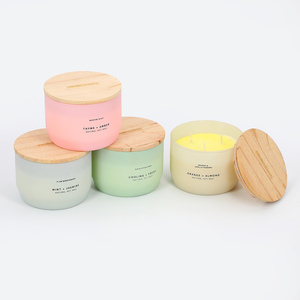
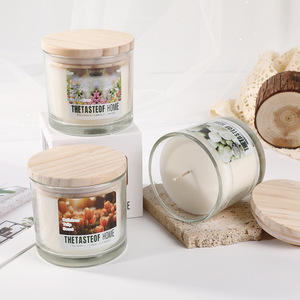
Russian fragrance preferences lean heavily toward dense, complex scent profiles—such as cedarwood, amber, leather, Siberian pine, and vanilla spice. To prevent terpene oxidation and scent migration during multi-week transit, glass containers are paired with custom-turned beechwood, pine, or bamboo lids featuring food-grade silicone ring gaskets. Silicone hardness is calibrated to 50 Shore A, retaining elasticity even at -35°C to preserve an airtight seal.
OEM/ODM Manufacturing Capabilities
Precision Moulding
Custom 3D CAD/CAM mould engineering within 7 days. Ability to execute complex geometric wall patterns, inner ribs, and embossed brand logos directly on glass walls.
Advanced Decorating
Automated inner-wall spray lacquering, metallic vacuum electroplating (gold, rose gold, matte black), UV coating, and high-temp decal firing up to 600°C.
Localized Application Scenarios in the Russian Market
Understanding how glass vessels are deployed across different commercial verticals in Russia allows importers to optimize vessel specs for maximum retail velocity.
High-end boutique hotels, dining establishments, and wellness centers along Nevsky Prospekt and Tverskaya Street require heavy-weight glass vessels (300ml–500ml) with opaque matte black or metallic copper coatings. These vessels must obscure melt pools between uses while reflecting ambient lighting. Borosilicate or thick soda-lime glass is required to sustain continuous 6-to-8-hour burn cycles without outer surface overheating.
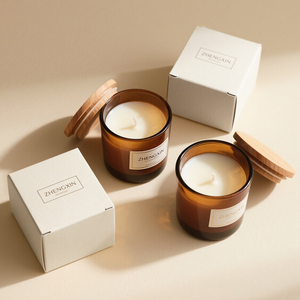
During long winter months spanning October through April, Russian consumers spend extended periods indoors. Home scenting is considered a key element of residential comfort. Frosted glass and amber apothecary jars are favored for high-fragrance-load soy candles (8%–12% essential oil concentrations). The amber tint shields UV-sensitive aromatic compounds from degradation caused by ambient sunlight or indoor LED rays.
D2C sellers require lightweight yet shatterproof glass jars packaged in drop-test-certified mailers (5-ply corrugated cartons with custom-cut EPE foam inserts). Standard sizes like 100g, 130g, and 200g cylindrical vessels dominate this sector due to standardized postal weight brackets across Russian Post and CDEK logistics routes.
Macro Trends & Regulatory Compliance in Russia
1. Financial Clearance & Direct RMB Settlement
With Western financial channels restricted, top Chinese exporters have established direct VTB Shanghai, CIPS (Cross-Border Interbank Payment System), and local regional bank channels allowing seamless RMB/Ruble payment processing. Russian buyers avoid exchange-rate slippage and intermediary banking blockades, streamlining procurement cycles.
2. EAC Mark & GOST-R Technical Certification
All imported candle vessels and pre-filled candles must comply with Eurasian Conformity (EAC) regulations. Glass containers intended for consumer home use undergo chemical leaching testing under GOST standards to confirm zero release of cadmium, lead, or arsenic from internal glass surfaces or decorative coatings when exposed to acidic or thermal environments.
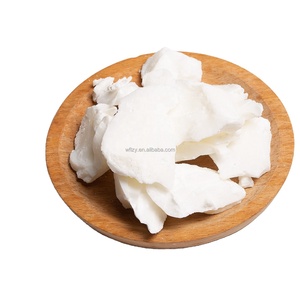
Russian consumers are increasingly rejecting traditional petroleum-derived paraffin candles in favor of eco-friendly soy, coconut, and beeswax blends. This shift necessitates specialized glass container geometry: soy wax has a lower melting point (45°C–52°C) than paraffin, requiring wider container diameters to foster proper melt pools and prevent tunneling.
Need Custom Moulding or Direct Factory Procurement?
Our engineering team provides end-to-end OEM/ODM support for Russian importers, including CAD design, thermal testing reports, EAC documentation, and customs clearance support.
How do your factories prevent glass breakage during Siberian winter transit?
We utilize computer-controlled annealing lehrs to eliminate internal glass stress (≤ 5 MPa). For packaging, we use heavy-duty honeycomb dividers, individual polybags, thermal wrap, and reinforced 5-ply export master cartons strapped onto fumigated plastic pallets with shrink wrap protection against moisture and freezing winds.
What payment methods and currencies are supported for Russian buyers?
We support direct Chinese Yuan (RMB) payments via VTB Bank (Shanghai branch), CIPS transfer, and direct bank-to-bank Ruble transfers. This eliminates SWIFT friction and ensures immediate order confirmation and production allocation.
What are the primary logistics corridors used for shipping to Russia?
Depending on budget and urgency, we offer three main routes: Direct Overland Rail Freight via Manzhouli/Zabaikalsk to Moscow (12–15 days), Sea-Rail Multimodal via Vladivostok/Vostochny (18–22 days), and Express Trucking via Khorgos for Central Russian destinations.
Are your products compliant with EAC and GOST-R regulations?
Yes. Our glass vessels and raw soy waxes undergo rigorous laboratory testing. We provide full Material Safety Data Sheets (MSDS), Heavy Metal Test Certificates (lead/cadmium-free), and documentation necessary for your customs broker to issue EAC declarations upon import.
What is the Minimum Order Quantity (MOQ) for custom-colored glass jars?
For standard in-stock glass shapes requiring custom spray lacquering or electroplating, our MOQ starts at 3,000 units per colorway. For entirely custom 3D glass moulds, the MOQ is typically 10,000 to 20,000 units depending on vessel weight.
Can you supply matched wooden lids and custom packaging boxes?
Absolutely. We offer complete turn-key solutions including custom-milled beechwood, oak, or bamboo lids fitted with silicone sealing rings, custom-printed rigid gift boxes, soft block soy wax, and pre-cut lead-free cotton wicks.
Why Partner With Our China Export Facilities?
Navigating international trade requires a manufacturing partner who balances technical excellence with agile supply chain management. By combining state-of-the-art glass forming machinery, rigorous quality control checkpoints, deep familiarity with Russian import tariffs, and robust financial clearing options, we empower brands, wholesalers, and contract manufacturers across the Russian Federation to scale their operations confidently.